Some say Rock N Roll will never reach the same primitive raw vein hit of Bo Diddley at his more subhuman lurch or no unit can ever scramble the marbles left of what brain boiling suburban electronic punk outsiders did in the mid 70's: Whatever you think, there is no denying the homemade nuclear war Wolf Eyes has left on music. Wolf Eyes was birthed in the shadows by a few liked minded individuals: Nate Young, Aaron Dilloway and John Olson in the late 90's in Michigan. However, Wolf Eyes has become more than band, but a collective mutant ensemble, an art abstraction unit: musicians, print makers, photographers and more, all who share a primal shadowy vision of decoding the wilderness into the soul of humanoid from the deep audio arsenals.
Today, Wolf Eyes are pleased to announce their return with a European tour (a US tour to follow) and a new a record, No Answer : Lower Floors. Wolf Eyes are returning to longtime friend base and Interzone of outsider art, De Stijl Records, with whom the band worked on No Face Lives, their collaboration with Smegma and the loner blues cerebration unit Stare Case's, Lose Today.
The No Answer : Lower Floors material covers all bases: tough to toughest to tangled, all done in the Wolves' least convoluted smooth style simple yet tangled rhythms. The vocals, delays, primitive electronics, woodwinds and raw guitar of newest member Jamas Baljo create a new destroyed space to crawl through. No Answer: Lower Floors was recorded and mixed at the Michigan Underground Group's gambling/clubhouse/art space, with the usually 2D-flat quality of the drums and electronics given creeping new brightness-life within the hollow echo acoustics of the sacred space's cinder prisons. No Answer : Lower Floors shares a natural feel with previous Wolf Eyes efforts but goes much further in detailing their underworld of odd melodies and mangled harmonics. Within their system-based economic compositions, there remains zero room for wasted space. The whole record is less internal misery and more colorful: of a "could be life on mars" zone than rainbows.
No Answer : Lower Floors features former members Aaron Dilloway and Mike Connelly, and thus is a family homecoming of sorts. More important, it's the dawn of a new Wolf Eyes era. As the desconstructed skull mangled on the cover states: its RNR from a waste world of 2001244 A.D.
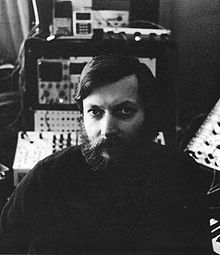
Belgian electronic music composer André Stordeur was born 1941 in Haine St Paul.
His musical career started in 1973 with a tape composition for the soundtrack to a film on Gordon Matta-Clark titled Office Baroque, by Eric Convents and Roger Steylaerts. Later in the 1970s, he participated to avantgarde music ensemble Studio voor Experimentele Muziek, founded in Antwerp, Flanders, by Joris De Laet in 1973. S.E.M.'s associate composers in the 1970s included: Dirk Veulemans, Paul Adriaenssens, Karel Goeyvaerts, Lucien Goethals and Serge Verstockt. Stordeur founded his own electronic music studio Studio Synthèse in 1973 in Brussels.
In 1979, he collaborated with Paul-Baudouin Michel on an electroacoustic music composition titled Phraséologie, recorded at the Institut voor Psychoacustica en Elektronische Muziek studio, aka IPEM, the Ghent University electronic music studio since 1962. Also in 1979, he published a solo recording of his electronic music titled 18 Days, with compositions using an EMS AKS and a modified 8 voice patchable Oberheim SEM1 system.
Since 1980, Stordeur composes exclusively on Serge synthesizer, either a Serge series 79 and a Serge prototype 1980, which was especially built for him by Serge Tcherepnin himself. Since 1983, Stordeur is Serge company's official consultant for Europe.
In 1981, Stordeur composed the music of Belgian film director Christian Mesnil's documentary Du Zaïre au Congo. He studied at IRCAM in 1981 with David Wessel and then flew to the US to study with Morton Subotnick, who was also a familiar figure at IRCAM between 1979 and 1981.
Stordeur became an influential sound synthesis teacher and, in 1997, completed his Art of Analog Modular Synthesis by Voltage Control, a guide to everything modular (Serge, EMS, etc.). Stordeur maintains the Analog Cottage website, where he offers some of his advices and articles.
In 2004, he contributed one track to a Serge synthesizer revival CD titled Serge Modular Music: Now, published by Egres, California. In 2009, Stordeur appeared on a version of Giacinto Scelsi's Tre Canti Popolari, published by the Sub Rosa (label), where he played electronic distortion of live instruments.

Process of Guilt started their existence in early 2002 having their foundations firmly based in doom and dark music. In late 2006, after self-releasing the «Portraits of Regret» and «Demising Grace» demos, the four musicians gave a stronger and more concise production to their own brand of doom leading to the release of the debut album, «Renounce».
Paving the ground for the release of their second full-length «Erosion» in late 2008, Process of Guilt unleashed three limited releases on the masses: a split 10” with british master of mystery Caïna, a remastered version of «Demising Grace» on pro-CDr and tape versions of the debut album and the demos.
In 2009,«Erosion» progressed even further from the post-doom sound crafted on their much lauded debut. With this release, the four musicians kept spreading their creative wings, breaking down genre boundaries and solidifying their very own personality. All this complemented with a considerable list of impressive and devastating performances while sharing the stage with acts as diverse as The Ocean, Intronaut, Minsk, A Storm Of Light, Katatonia, Napalm Death or Rotten Sound.
In early 2011, closing the process started with «Erosion», «The Circle» presented five reinterpretations of the last song on the highly acclaimed sophomore album and opened the door for the composition process of the decisive third album. Bringing together the creative minds of Sanford Parker, Echoes Of Yul, DJ Mofo, Bosque and Sons Of Bronson, this experiment offered a deconstructive circle through an erosive world of calm versus chaos, (re)mastered by well known James Plotkin.
3 years after the release of «Erosion», Process of Guilt finally return with their most accomplished effort to date. Exploring the monolithic roots of their music even further, «FÆMIN» displays a new level of heavyness and purpose for the four-piece, while preserving the dark atmospheres already associated with their music intact. Mixed by Andrew Schneider (at Translator Audio Studios in New York) and mastered by Collin Jordan (at The Boiler Room in Chicago), «FÆMIN» builds upon 5 concise tracks, shorter for the band standards, but overall more intense and scorching than anything they’ve done before. Steadily moving through dynamic rhythm changes, the band explores a more diverse vocal approach, mantra-like grooves, a crushing rhythm session, an everlasting love for feedback and more huge riffs than you can ask for in under 45 minutes. With «FÆMIN», Process of Guilt paint desolate sonic landscapes and dig their own place in the scene even deeper.